

| Efficient database reorgs
consist of fast unload, sort and reload operations. Similarly,
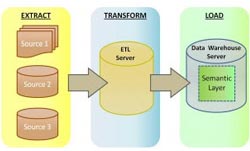
in large ETL and database migration environments, data warehouse
experts like Dr. Ralph Kimball recommend that data are staged
in flat files. That is because the fastest sort, join, convert,
aggregation, report, and reload processing occurs in the file
system. Transforming big data within the database or BI layer
is taxing and inefficient. Data stored in proprietary formats
and structured DB/ETL systems are optimized for queries, not for
transforms or loads.
Description
The CoSort Fast Extract (FACT) tool rapidly unloads
large Oracle tables to external files, using all supported
combinations of native SQL SELECT features. The data is quickly
available for any purpose, including: reorgs, transforms, pre-load
sorting, migrations, change and summary reporting, ETL, replication,
testing, and masking. If you also have CoSort's SortCL
tool, you can perform or accelerate all of these processes at once.
But you do not have to use SortCL; i.e. once the data are in flat
files, you can do anything you want with them.
FACT's extract performance is second to none. Using superior connection
protocols, parallel hints, and a variety of other proprietary techniques,
FACT's unload rate is much faster than Oracle's spool function.
Benchmarks show flat files are produced many times faster through
FACT than through SQL*Plus or ODBC operations. And unlike Oracle
export and data pump, FACT creates portable flat files. FACT consumes
only a small amount of system resources, without the need for load
balancing.
In addition to speed, FACT includes several useful file layout
options, including:
• custom date and timestamp formatting
• numeric data re-alignment
• fixed or variable record formatting
• delimiter and frame character choices
• column trimming (width reduction)
• packed decimal to numeric conversion
• varchar length displays
• null number casting
• line-feed character removal
To use FACT to unload Oracle from the command line, enter:
fact ini_file
where ini_file is a simple-to-use text or XML file
that identifies the database, extracts with a SQL SELECT command,
and specifies the unload target's format and destination (pipe or
files). You can execute FACT from the shell, a batch script, or
program.
FACT also works hand-in-hand (via metadata creation) with CoSort's
SortCL (transformation and reporting) program and Oracle's SQL*Loader
(bulk load utility) to consolidate the entire database reorg (or
data warehouse ETL) process into a single-pass
operation, and to perform reporting, replication, conversion,
and row/column security functions (also at the same time).
To summarize, FACT for Oracle is the quickest way to simultaneously:
• perform bulk unloads
• produce differently-formatted data files from a table
• create CoSort
metadata for transforms, reports, pre-sorts
• create metadata for bulk loads using SQL*Loader
• create RowGen metadata for
generating Oracle test data
Integrated Reorg and ETL Operations
With FACT, data warehouse architects can optionally
pipe together a complete and very fast Oracle reorg or ETL process.
Execute the .ini file together with a CoSort SortCL job specification
file (.scl) that references the .ddf that FACT automatically creates,
and with a SQL*Loader process that uses the control file metadata
that FACT also automatically creates. This is this operational template:
fact -c ini_file; fact
ini_file | sortcl /spec=transform.scl
/spec=fact.ddf | sqlldr control=fact.ctl
direct=true
This command initiates a rapid table extraction and pipes it to CoSort's
SortCL program for simultaneous field filtering, sorting, aggregation,
conversion, protection, reformatting, replication, and/or reporting
(transform.scl). In turn, the SortCL output
is piped, pre-sorted, in index order to SQL*Loader. No other
ETL solution offers this level of parallel processing performance,
versatility, or ease of use -- while simultaneously relieving the
database of so much overhead.
Platform Availability
FACT is currently available for AIX, HP-UX (PA-RISC and Itanium),
Linux (x86 and IBM zSeries), Solaris (SPARC only), Tru64 Unix, and
Windows 2000, 2003, XP and Vista. CoSort and its sort control language
(SortCL) program for data transformation is available on these platforms,
as well as many others where you might choose to otherwise process
the FACT-extracted data. See the CoSort product description for
a complete list of CoSort-supported platforms.
Licensing and Support
FACT license fees cover perpetual use and depend on the number of CPUs or cores you wish to license. FACT copies
can be licensed alone, or in discounted conjunction with a
CoSort license bundle. Annual maintenance charges for FACT,
which is an optional coverage for technical support and software
upgrades, costs 20% of the base license fee, or 15% with a
CoSort license on
the same platform.
See also:
FAQ > Oracle Acceleration
Solutions > ETL/DB Acceleration > Oracle
Solutions > Data Transformation
Solutions > Business Intelligence
Solutions > Field Protection (Data Security)
Products > CoSort > SortCL
Products > CoSort > SortCL Metadata
Products > RowGen (Test Data) |
Need
Faster Loads, too?
1. Unload table data to a flat file using
Fast Extract (FACT) for Oracle.
2. Sort the file on the longest index field using any
CoSort interface.
3. Load Oracle using SQL*LOADER and the
argument DIRECT=TRUE.
4. Create indexes during the load using
the clause SORTED INDEXES in the .ctl file. Or, to create the
indexes after loading, use the CREATE INDEX command with the
NOSORT option.
Do this all in one pass! See "Integrated
Reorg and ETL Operations" on this page and our Oracle Acceleration
FAQ. |
|